God Creates His Angels
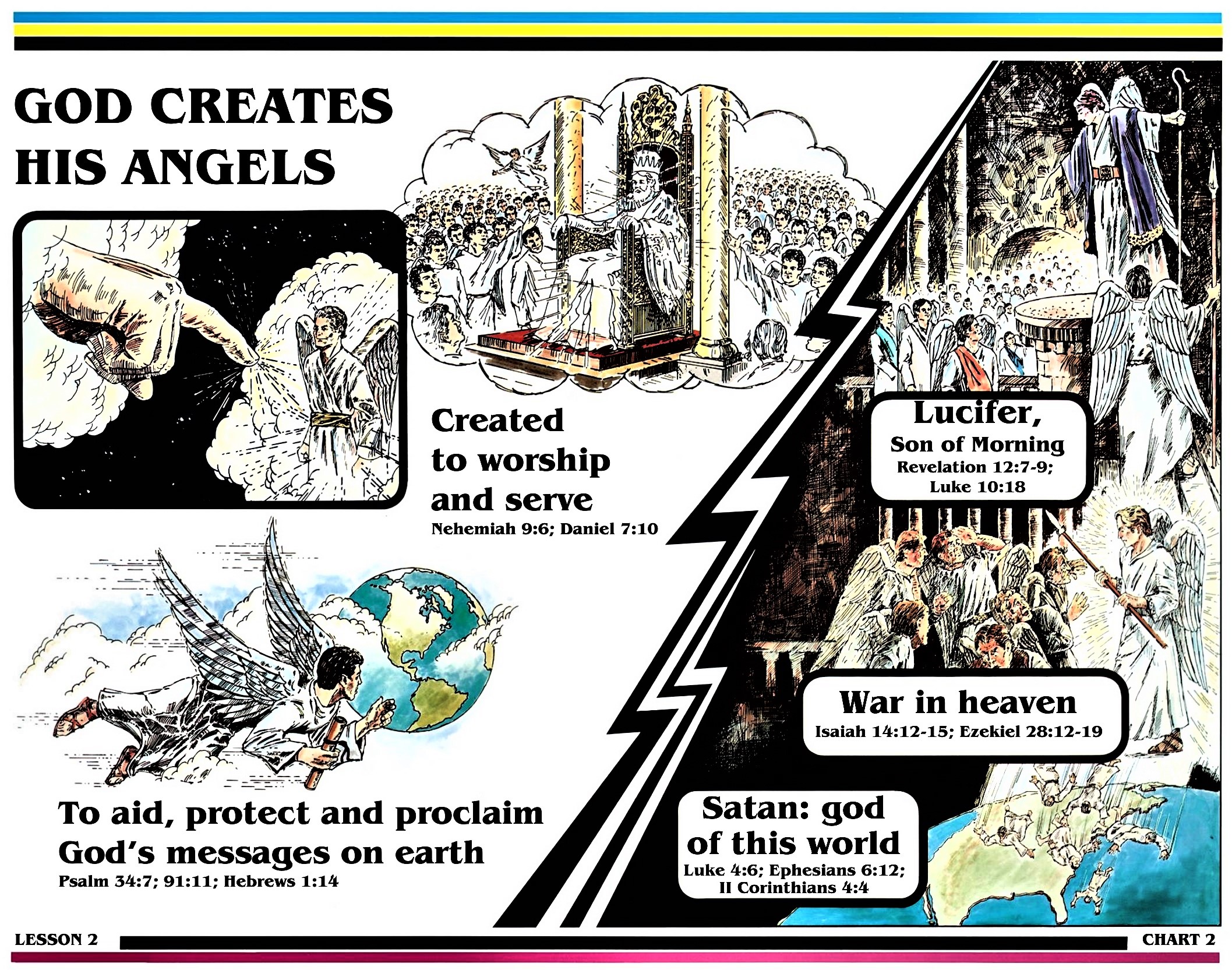
Chart Objective:
To explain the creation of angels and their specific duties. Because the archangel Lucifer rebelled, he was cast out of heaven. Later, this fallen angel became known as Satan, man’s worst enemy and finally, the “god” of this world.
Chart Outline:
A. God’s angels created to worship and serve
B. To aid, protect and proclaim God’s messages
on earth
C. Lucifer, Son of Morning
D. War in Heaven
E. Satan: god of this world
A. God’s angels created to worship and serve – Nehemiah 9:6; Daniel 7:10
Since God is eternal, at one time He alone existed. We can only speculate how long He was alone or what occurred in eternity past. The Bible does imply that before Adam was placed on earth, angels were with God:
“Where wast thou when I laid the foundations of the earth? . . . When the morning stars sang together, and all the sons of God shouted for joy?” (Job 38:4, 7).
Before the creation of man, there were angels. The first and highest order of created beings is the angelic host:
“Praise ye him, all his angels: praise ye him, all his hosts. . . . Let them praise the name of the LORD: for he commanded, and they were created . . . He hath also stablished them for ever and ever” (Psalm 148:2, 5, 6).
“Thou, even thou, art LORD alone; thou hast made heaven, the heaven of heavens, with all their host, . . . and the host of heaven worshippeth thee” (Nehemiah 9:6).
God planned for angels to worship and praise Him. While viewing the celestial setting of heaven, John described the wondrous beauty of angels offering their praise and worship to God:
“And I beheld, and I heard the voice of many angels round about the throne and the beasts and the elders: and the number of them was ten thousand times ten thousand, and thousands of thousands; saying with a loud voice, Worthy is the Lamb that was slain to receive power, and riches, and wisdom, and strength, and honour, and glory, and blessing” (Revelation 5:11-12).
Angels were also created to serve. Their servitude has never changed. Although man was given a nature lower than that of angels with a like purpose of serving, man’s position is subject to be elevated above theirs. When we are recreated as sons of God, angels become our servants:
“Are they not all ministering spirits, sent forth to minister for them who shall be heirs of salvation?” (Hebrews 1:14).
Angels will always fulfill the role of servants. Yet they serve believers only at God’s bidding. They minister to the heirs of salvation. While we have no authority to command angels, when we ask God for help, He will direct them to assist us.
B. To aid, protect and proclaim God’s messages on earth
Psalm 34:7; 91:11; Hebrews 1:14
Skepticism about the existence of angels should be resolved after one closely studies God’s Word. The Bible reports many instances when God used angels for divine assignments.
Angels comprise a unique portion of the Bible. To eliminate their appearances would remove the vast beauty and excitement of Scripture.
They come and minister, then disappear. They were present at the beginning of the world. They will be present at the end of time to assist in executing judgment on the earth. Throughout Scripture, God commissioned His angels to perform special assignments on earth. They were directed to administer aid in a crisis, to provide protection from danger, or to bear God’s own message. It was such an angelic host which announced Christ’s birth to shepherds on the Bethlehem hillsides.
Angels have assumed many different forms and manifestations in fulfilling God’s divine plan for the destinies of men and nations.
They have altered the course of busy political arenas of the world and protected countless saints from dangers. How thankful we are for their invisible presence and unceasing labors.
C. Lucifer, Son of Morning
Revelation 12:7-9; Luke 10:18
We presume that all the angels were created holy and perfect in their ways. While the Bible does not describe Satan’s origin, we are certain he, too, was created by God. Apparently various ranks or orders existed in the heavenly host as evidenced by three chief celestial princes: Gabriel (the mighty one), Michael (who is like God), and Lucifer (son of the morning).
From a passage in Ezekiel 28:13-19, we glean additional information about the tempter. Lucifer, the most exalted of all the angels, occupied a place of prominence, second only to God Himself. Vested with every grace and anointed as the guardian of God’s glory, he was the delight of the Lord. No other angel was more beautiful or wise or important. Lucifer was free to act as he wished.
Favored by God with precious gifts and talents, Lucifer coveted those blessings and allowed pride to corrupt his heart.
D. War in Heaven
Isaiah 14:12-15; Ezekiel 28:12-19
Ezekiel depicted Lucifer’s decline as a holy angel:
“Thou wast perfect in thy ways from the day that thou wast created, till iniquity was found in thee” (Ezekiel 28:15).
The first sinner! What separated this majestic angel from God? Rebellion, pride, and self-exaltation overwhelmed Lucifer’s holiness and caused his downfall.
A created being sought to dethrone the Creator! His revolt resulted in banishment and the pronouncement of divine judgment. Since “sin” means to rebel against God’s will, this suggests that sin began the day Lucifer rebelled.
Positioned second to God, Lucifer already commanded great forces. Using his leadership, he easily involved other angels in the rebellion. A passage in the Book of Revelation indicates that a third of heaven’s angels may have joined Lucifer’s ill-fated revolt against God:
“And there was war in heaven: Michael and his angels fought against the dragon; and the dragon fought and his angels, and prevailed not; neither was their place found any more in heaven. And the great dragon was cast out, that old serpent, called the Devil, and Satan, which deceiveth the whole world: he was cast out into the earth, and his angels were cast out with him” (Revelation 12:7-9).
“And he [Jesus] said unto them, I beheld Satan as lightning fall from heaven” (Luke 10:18).
Lucifer’s rebellion cost his position and banished him from approaching God’s throne. Consequently, the rebels moved to a new residence. Hell was created for the devil and his angels (Matthew 25:41). Eventually this evil host will dwell there throughout all eternity. But meanwhile, where could the usurpers go?
“He was cast out into the earth, and his angels . . . with him” (Revelation 12:9).
Here on earth? Yes! Invisible powers are present in our world. Their one purpose is to deceive, divert, and hinder the plan of God. Paul referred to these sinister beings:
“For we wrestle not against flesh and blood, but against principalities, against powers, against the rulers of the darkness of this world, against spiritual wickedness in high places” (Ephesians 6:12).
Lucifer’s name was changed to “Satan,” meaning “adversary.” His fallen angels were transformed into demons. The conflict which began in heaven rages to this day.
E. Satan: god of this world
Luke 4:6; Ephesians 6:12; II Corinthians 4:4
Although retaining his rank and dignity, Satan’s majesty was perverted. His wisdom and genius became craftiness and deceit. Satan eventually assumed the role described by Paul as ruler “of the darkness of this world.”
Having formerly dwelled in holiness and righteousness, Satan has knowledge of both good and evil. Therefore, he cleverly makes evil appear as good and good appear as evil.
Satan is the most notorious of all imposters and counterfeiters. But certain of God’s attributes cannot be duplicated. Satan is powerful, but not omnipotent. Having thousands of years experience in accumulating knowledge and monopolizing on human weaknesses, he is knowledgeable—but not omniscient.
Lucifer’s new role became that of a tempter, adversary, enemy of the righteous, and finally—“god of this world.” Paul described how Satan deceives the minds of men and diverts their attention from God:“In whom the god of this world hath blinded the minds of them which believe not, lest the light of the glorious gospel of Christ, who is the image of God, should shine unto them” (II Corinthians 4:4).