LESSON ONE – An Introduction to the Holy Bible
This lesson conveys the absolute authority of the Bible. In these days of uncertainty and confusion, it is comforting to know that our confidence rests upon the very words spoken by God—the Bible! Nor has He left us without proofs of the credibility of His Word.
We can speak with authority about Christianity, knowing that there is an intellectual basis for our faith in Jesus Christ. Without a solid scriptural foundation, we could not intelligently or convincingly present the “good news.” Therefore, we want to begin this series of lessons by clarifying that our faith rests upon the most substantial basis possible— the Word of God.
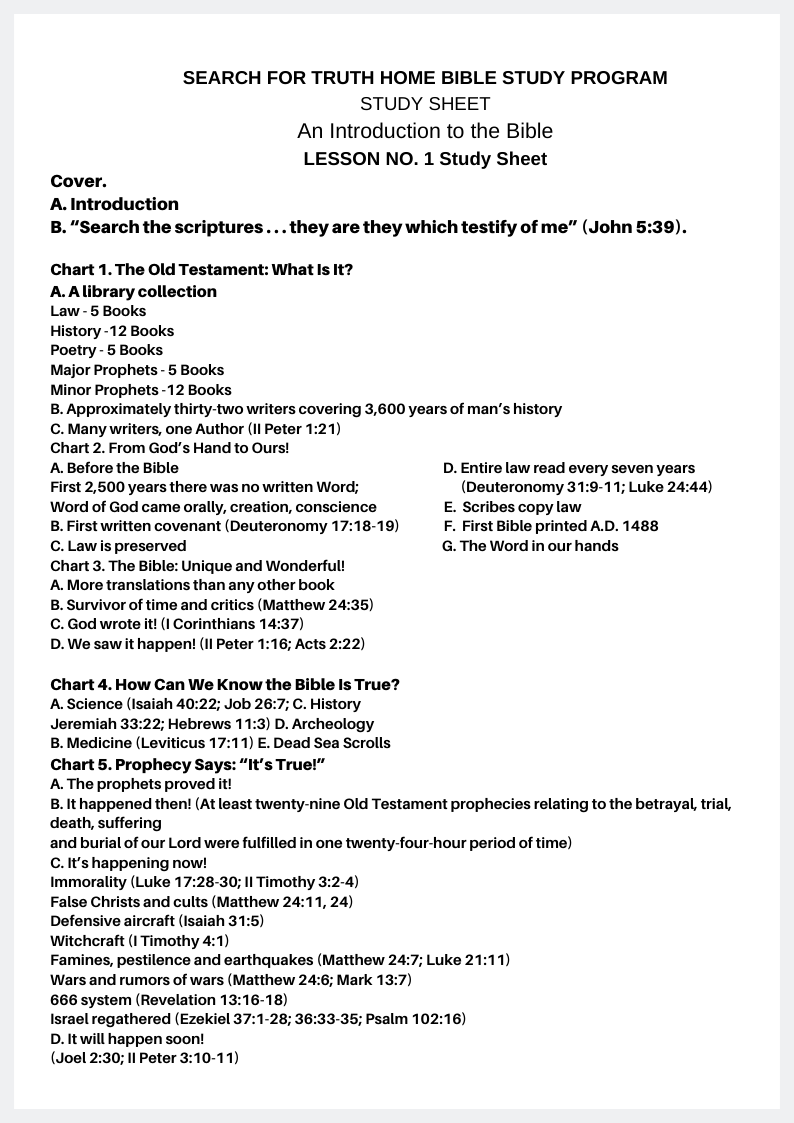
When completing this lesson, students should be aware of the following concepts:
1. There is complete harmony and agreement among Old Testament books.
2. The Scriptures have been proven to be authentic and accurate in these fields of learning: Science, Medicine, History, Archeology, Dead Sea Scrolls.
3. The greatest proof that the Bible is indeed a divine Book, inspired of God and without error, is the fulfillment of prophecy, both in Bible times and our present day.
4. We can place full confidence and trust in the Bible as the foundation for building our lives. We can be sure the Bible is true!
Books for additional reading:
1. Josh McDowell, Evidence That Demands a Verdict, San Bernardino: Here’s Life Publishers, 1979.
2. Arthur S. Maxwell, Your Bible and You, Washington, D.C.: Review and Herald Publishing Association, 1959.
3. Ralph Earle, How We Got Our Bible, Grand Rapids: Baker Book House, 1971. 4. F. F. Bruce, The Books and the Parchments, Rev. ed. Westwood: Fleming H. Revell Co., 1963.
5. F. F. Bruce, The New Testament Documents: Are They Reliable? Downers Grove, IL 60515: InterVarsity Press, 1964.
Lesson 1 – Cover